
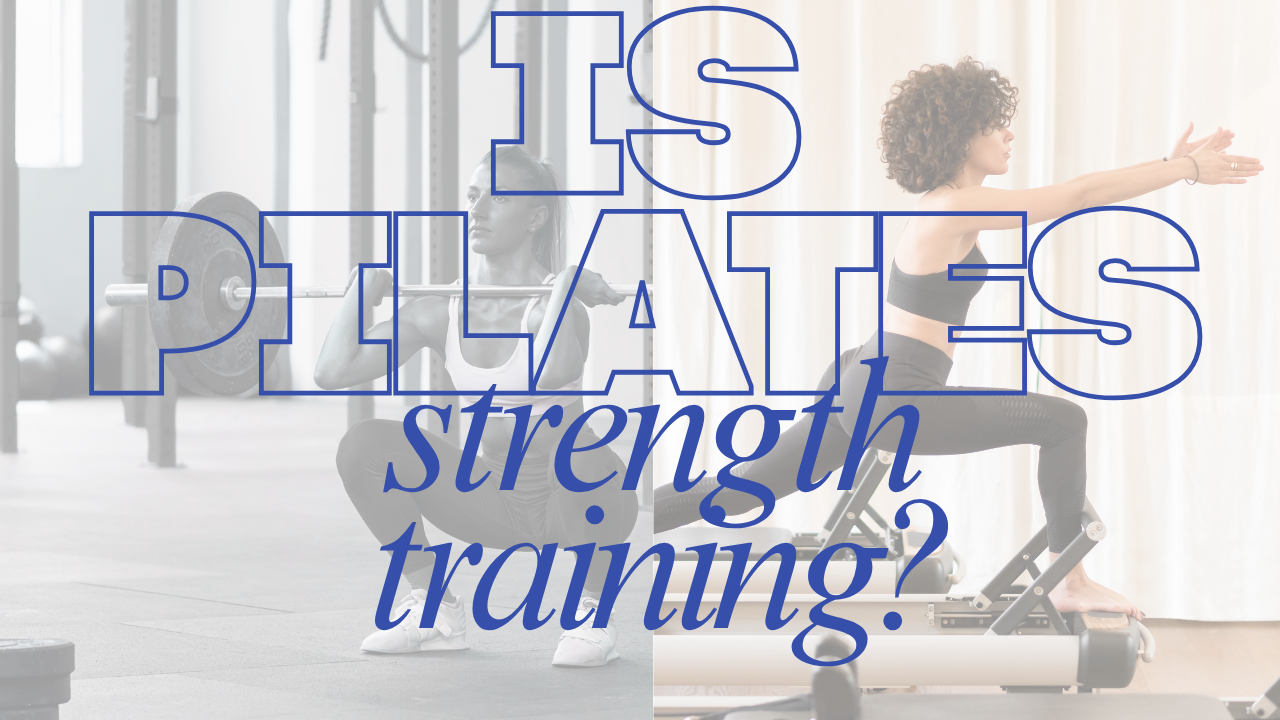
Is Pilates Strength Training or What?
May 18, 2026
This seems to be the topic of conversation lately. Pilates is having a moment and so is the importance of strength training, specifically for women in the 35-65 range. Language is moving away from “don’t get too bulky” (even though Pilates marketing is still firmly entrenched in Pilates Body language) to “build muscle for bone health” and “exercise to increase your healthspan, not just your lifespan”. While we know Pilates is resistance training (we are working against the load of the springs) there has been considerable debate as to whether Pilates is legit strength training, as in, does Pilates help us build muscle for bone health, increase strength, and increase muscle endurance? There’s a good amount of nuance here.
In the last 6 years Pilates has seen an industry wide growth of nearly 40% according to the most recent SFIA report. While the report doesn’t specify the difference between growth in specific sectors of Pilates (boutique vs larger membership style studios) it means that more people are being exposed to a movement modality done on on reformers and mats and the general public is less likely to equate Pilates with stretching or Yoga. In my opinion, this is a win for the industry as a whole regardless of what style of Pilates you practice. *We can have a conversation about how the rise in Pilates (a fully unregulated industry with no copyright to the word) affects liability insurance across the board, which is the biggest concern I see emerging from this rapid fire growth* Overall, the focus on moving more is beneficial for us all, especially when over 75% of Americans don’t meet the ACSM exercise guidelines. Quibbling about whether people are doing the “right” kind of Pilates is wholly missing the point, frankly.
Why is Pilates seeing such an exponential increase in participation? It could be that both boutique and franchise model studios are benefitting from large “fitness reformer” classes, generally the class model that’s in franchise studios. Fitness reformer classes have made Pilates accessible for way more people than the boutique style studios have historically. Bigger classes = cheaper classes = more accessible for more people = more people doing Pilates. I see this as a win regardless of what type of Pilates you teach.
*just a note: no one should be teaching unsafe classes and there does, IMO, need to be a distinction between a weekend certification and a 500+ hour certification. What we agree is “safe” vs “unsafe” is another conversation.
The thing that fitness reformer classes (and classical pilates) do really well is bridge the gap between strength training and Pilates. Pilates, in its most original iteration as Contrology, was resistance exercise more than anything else. But, knowing what we know now about how much load or volume it takes to build muscle that is significant enough to impact bone health, metabolic health, and strength, the question becomes: is Pilates the best place to do that? Beyond initial adaptation for the very novice mover, the amount of load offered by the springs alone and the practical application of enough volume in a class setting makes anything beyond initial gains unlikely. As in, clients will progress their strength initially and then they will likely hit a plateau if they don’t incorporate other modalities outside of Pilates or you as their Pilates instructor add weights to their studio time. And I’m not talking about doing loaded squats and thrusters on a moving reformer, I’m talking about a deviation from Pilates in the Pilates studio, or maybe picking up a weight during Eve’s lunge or side overs. And to understand how to add weights effectively we need to understand something about progressive load, muscle, bone, and soft tissue adaptation, biomechanics, and pain. We need some basic foundational knowledge that goes beyond the repertoire.
We likely don’t need another Pilates workshop, we need basic exercise science taught with the pIlates instructor in mind.
Don't miss a beat!
New moves, motivation, and classes delivered to your inbox.
We hate SPAM. We will never sell your information, for any reason.
