
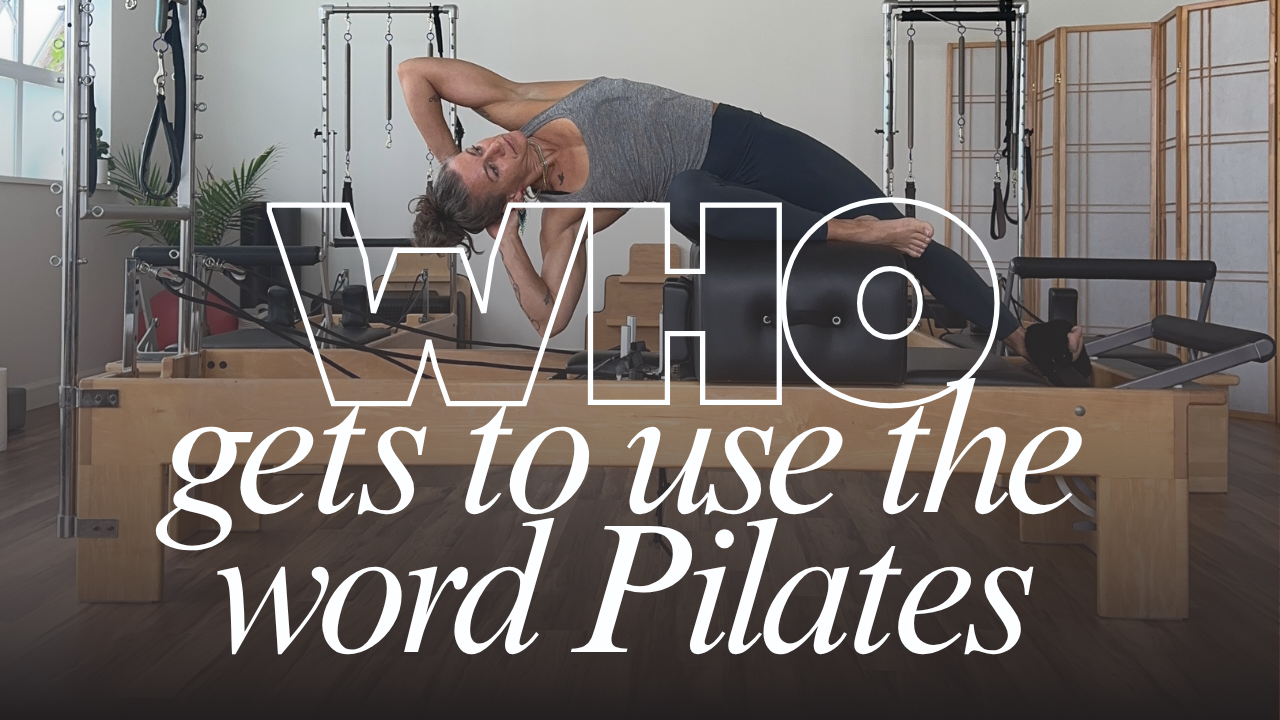
Who gets to use the word Pilates?
May 18, 2026And does it even matter?
Even writing that headline gives me the ick a little bit. The idea that certain people get to gatekeep words doesn’t sit particularly well with me. However, there is some nuance here that I go back and forth on, seemingly changing my thoughts on the subject every day. I may even have a different opinion than the one on paper here by the time I finish writing this. So how's that for a non-committal introduction to an opinion piece.
My most recent musing on the subject came after taking a class at a new studio that opened in the downtown area where I live. I am always interested in scoping out new studios in town so I have a place to send people who contact me but aren’t in the market for privates. I like to get to know the product I am recommending. So there I went. And I kinda knew what I was getting into.The studio advertised itself as
Pilates in overdrive
Fusing classical practice with cardio and resistance training
Uses light weights and loud music
Okay. Cool. I was expecting a loose interpretation of Pilates with louder music. And honestly, that’s pretty much what I got. Class was programmed in what I interpreted as “blocks” where one sequence of 2-4 exercises were repeated 3x. Not really Pilates exercises. Not really strength training. Not really cardio either. The instructor was fine but seemed to be a more general “fitness” instructor and not one who went through a Pilates program outside of maybe a weekend course. She was fine. Pretty mediocre cues (mostly about posture and if you didn’t do it right you’d hurt yourself) around how to “keep pushing through the burn”. Nothing amazing. We did feet in straps (thank the lord) and standing side splits and a nice stretch that I gave all my clients the following week and I walked away with a sore butt the next day. So worth $20 but I likely won’t go back or recommend that as a good Pilates studio for clients looking for Pilates.
I just kept thinking to myself “why would I choose to come here and do this class”
It didn’t do anything very well. It wasn't really Pilates. Wasn’t really strength training. Wasn’t really cardio. It was like the color khaki. Or like sticking your hand in luke warm water. Or like listening to smooth jazz. It was just…meh.
And if you know what Pilates is you would walk out of that class thinking that it wasn’t a good representation of Pilates. And if you didn’t know what Pilates was you might walk out of that class loving it and then go to a different Pilates studio (more traditional) and thinking that the more traditional studio wasn’t a good representation of Pilates. From a consumer perspective, it’s fucking confusing.
And so this is where I waver: No one should get to decide who gets to use the word Pilates but if we walk into a class that we’ve paid for thinking it’s going to be one thing and then it’s something very different, it’s not a good look for Pilates. Like, Kleenex is a brand name but we also use it to refer to general tissue paper. If I bought an off brand Kleenex and it was too thin to blow my nose with I’d be bummed and think Kleenex was not something I could use to blow my nose. Next time I’d opt for a paper towel or toilet paper. Maybe I’ve lost the plot, but my point is when a name is attached to something you also expect certain things from it. And so, yeah, I think if Pilates is in the studio name it should represent Pilates more than just exercise on a reformer.
And here is where I start to argue with myself about the inevitable conversation about industry regulation that comes from debating what gets to be called Pilates and what should be called something else. Because who gets to decide what Pilates is? Even within more traditional style studios (and I’m including Club Pilates in traditional style studios) there is considerable debate about what exactly Pilates is.
Is it the exercises?
Is it the equipment?
Is it the principles?
Is it the movement order?
None of those give me a satisfactory answer. I lean towards the equipment being the defining factor, but my last class kinda proved me wrong. It was on a reformer. A balanced body allegro II. But this was not what I would consider Pilates.
And the industry as a whole seems to be equally confused. I recently posted a video about a movement where I highlighted someone doing what I thought was a great highlighting why a movement was challenging in one way on heavy springs and challenging in a different way on light springs. It was an excellent example of how to use biomechanics to explain muscle demand. It deserved kudos. But there were lots of comments on my post asking why I wasn’t remarking on the movers “unstable pelvis” and “alignment issues” and that if we’re calling this Pilates then we might as well crawl in a hole and hide. Because, clearly, THIS wasn’t Pilates. I get curious when people make comments like that and with all sincerity ask them what they consider makes Pilates Pilates. Crickets. Or “if I need to tell you what Pilates is then you’re not really a Pilates teacher”, which always makes me laugh and is just a massive cop out. I really just want to have an interesting and thought provoking conversation! Why is that so hard??
And predictably, by the end of this article, we are no closer to making any kind of judgment about who gets to use the word Pilates.
I just want to be able to walk into a studio that has the word Pilates in the name and know what I’m about to walk into. *within reason
Don't miss a beat!
New moves, motivation, and classes delivered to your inbox.
We hate SPAM. We will never sell your information, for any reason.
